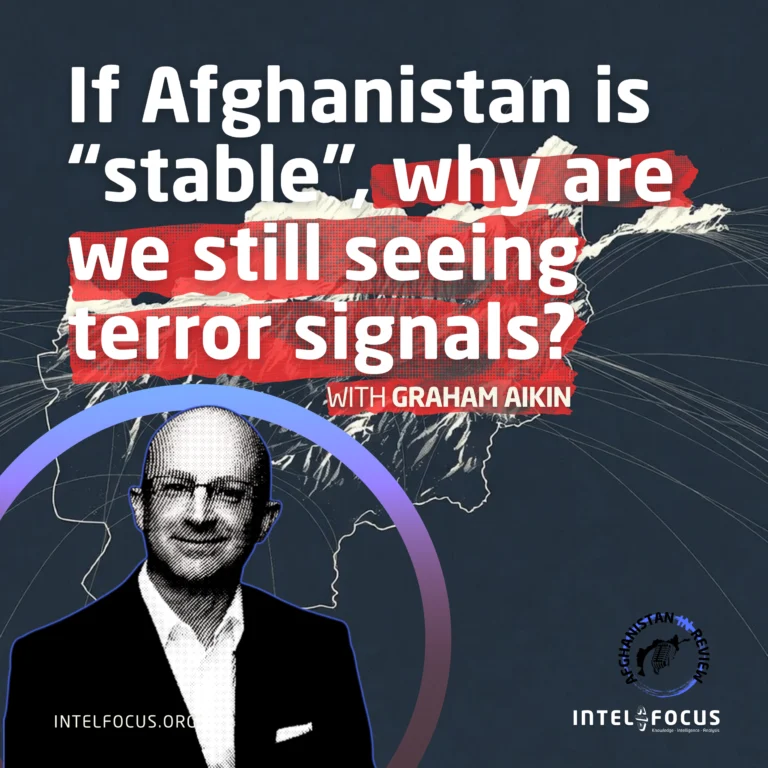
Afghanistan is increasingly discussed as a closed file, a conflict that ended when foreign troops left. But in this episode of Afghanistan in Review, Qais Alamdar makes a simple point: the story did not end, it just became harder to see.
Qais is joined by Graham Aikin, a terrorism and intelligence researcher focused on post-withdrawal Afghanistan. Their conversation is less about dramatic predictions and more about the practical problem of visibility. When access collapses, analysis starts to lean on fragments: patchy reporting, open-source clues, second-hand accounts, and political assumptions that rarely get tested in public.
Graham argues that this information gap has consequences. It changes what governments feel comfortable saying, what journalists can confirm, and what the public ends up believing. Networks do not need to be loud to be dangerous. Some thrive precisely because they can operate beneath the threshold of attention.
The episode also explores how narratives are managed. When incidents happen, official lines and local explanations can move quickly, sometimes flattening complex events into neat stories. Qais and Graham discuss why those messages matter, and what they reveal about credibility, denial, and the urge to project control.
A recurring theme is the tension between remote counter-terrorism and ground truth. Technical collection can be powerful, but Graham insists that human sources still matter, especially when the goal is to understand intent, capability, and relationships rather than just isolated events.
This is a conversation for listeners who want something more rigorous than hot takes. It is about how to think clearly when certainty is impossible: weighing claims without amplifying misinformation, spotting signals without chasing noise, and staying honest about what is known, what is suspected, and what remains unknowable.
If Afghanistan is off the front pages, this episode asks a sharper question: is the threat lower, or are we simply looking the wrong way?
More episodes
View all
How to think like an intelligence analyst | John Hall
The rapid growth of open-source investigation has blurred the boundaries between journalism, intelligence and publicly available information. For…
Why journalism is national security | Olivia Pirie-Griffiths
Journalism is facing more than a crisis of funding or trust. For Olivia Pirie-Griffiths, the pressures confronting journalism,…
“These values are not idealistic”: can the EU still defend its principles? | Dr Berit Ebert
Spotify content is blocked This embed would set cookies from a third party, so we only load it…