Sanctions exposure in Kazakhstan

A new Intel Focus investigation highlights continued sanctions-related risks linked to Kazakhstan’s trade in sensitive electronic goods, underscoring how post-2022 export controls remain vulnerable to circumvention.
The report focuses on dual-use goods, commodities that have legitimate civilian applications but can also be repurposed for military use. At the centre of the analysis are electronic integrated circuits and microchips classified under HS code 8542, alongside related items such as advanced computing components and telecommunications equipment. These goods are prioritised under US and EU export control regimes due to their relevance to weapons systems, intelligence platforms, surveillance technologies and unmanned systems.
Trade data indicate that Kazakhstan’s exports of HS 8542 goods to Russia, while lower than their 2022 peak, have not returned to pre-sanctions levels. In 2024, exports were valued at approximately 411,000 dollars, compared with around 245,000 dollars in 2021. This sustained elevation suggests that post-sanctions trade patterns remain structurally altered rather than temporarily disrupted.
Beyond Russia-facing exports, the investigation maps Kazakhstan’s broader role in global dual-use supply chains. Between September 2024 and August 2025, at least 324 export shipments of HS 8542 goods were recorded, with a declared value of roughly 873,000 dollars. These shipments involved 21 Kazakhstan-based exporters and 20 foreign buyers. Over the same period, imports of similar goods reached nearly 44 million dollars, highlighting Kazakhstan’s function as an intermediary node in the movement of advanced electronics.
Company-level profiling reinforces these risks. Iskracom LLP shows consistent import-export activity involving integrated circuit boards and switching systems sourced from China and Slovenia. Eltexalatau LLP operates at a far larger scale, with high shipment frequency and extensive trade in controlled electronics. Previous investigative reporting has linked the company and others to the re-export of Western dual-use components to Russian military-linked entities. Profi Top LLC, while limited in volume, illustrates how mirrored import-export transactions can still present sanctions-screening concerns.
The report does not assert illegality. Rather, the findings point to continued exposure to sanctions evasion and proliferation risk. Intel Focus assesses that Kazakhstan’s established role as a transit route for dual-use goods warrants enhanced monitoring, stricter compliance controls and sustained international scrutiny.
The full report is available to view and download below.
More investigations
View all
The apps that watch you: how stalkerware enables tech-facilitated abuse
Apps sold as parental control let abusers read a partner’s messages, track their location and stay hidden. Intel…

How propaganda travels across borders and online platforms
A comparison of how pro-Taliban, pro-Russia, pro-China and pro-Iran networks produce and amplify propaganda, and how organic and…
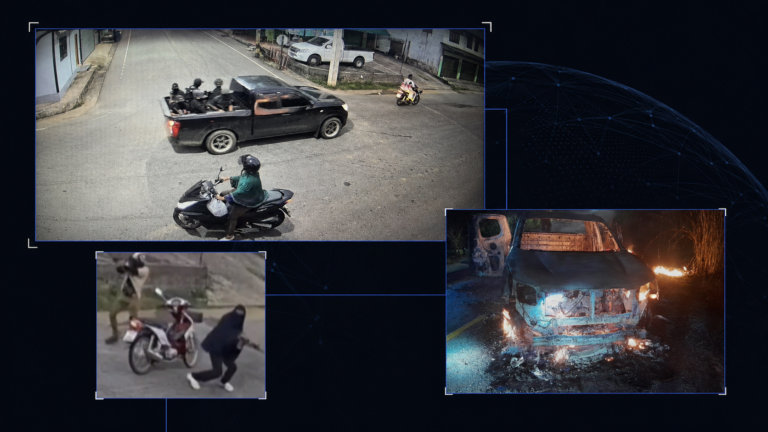
Insurgent attacks in southern Thailand: geolocation and analysis
Nine attackers, ninety seconds and two CCTV cameras. Intel Focus geolocates the checkpoint ambush that killed five Thai…