
How “Precision Strike” became the go-to word of modern war
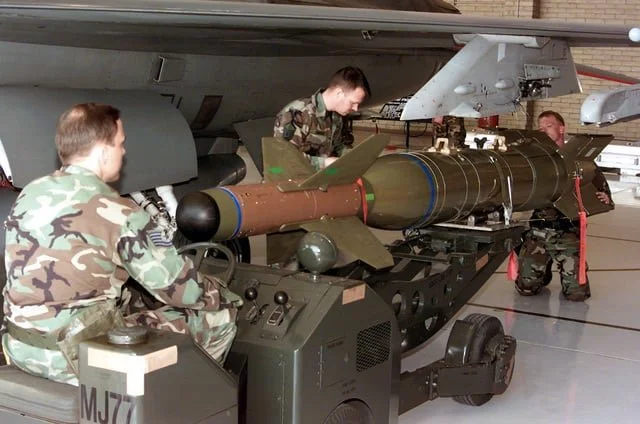
Teams from Raytheon Missile Systems, Lockheed Martin and Langley Air Force Base, Virginia, convened at Luke Air Force Base, Arizona, to test the compatibility of the Enhanced Guided Bomb Unit-27 with the F-16 Fighting Falcon aircraft. 1999 | Scene Camera Operator: SSGT Andrew Jacobus, USAF | Image link here
Author & Investigator: Shukria Malek Zada
After the most recent developments in the world, particularly regarding military operations, there is one term that we hear quite often. But perhaps, we have not paused to think of how and why it has become the go-to term for military operations. That term is “Precision Strike”.
What does a Precision Strike mean?
A PGM or Precision Guided Munition is a category of weapon system that integrates GPS and different laser-guided technologies that provide a high degree of accuracy while striking designated targets. It is argued that PGMs cause minimal collateral damage; however, this claim remains widely debated among both experts and the public. Hence, precision strike is a term that is used to describe a military attack intended to hit a specific target using PGMs.
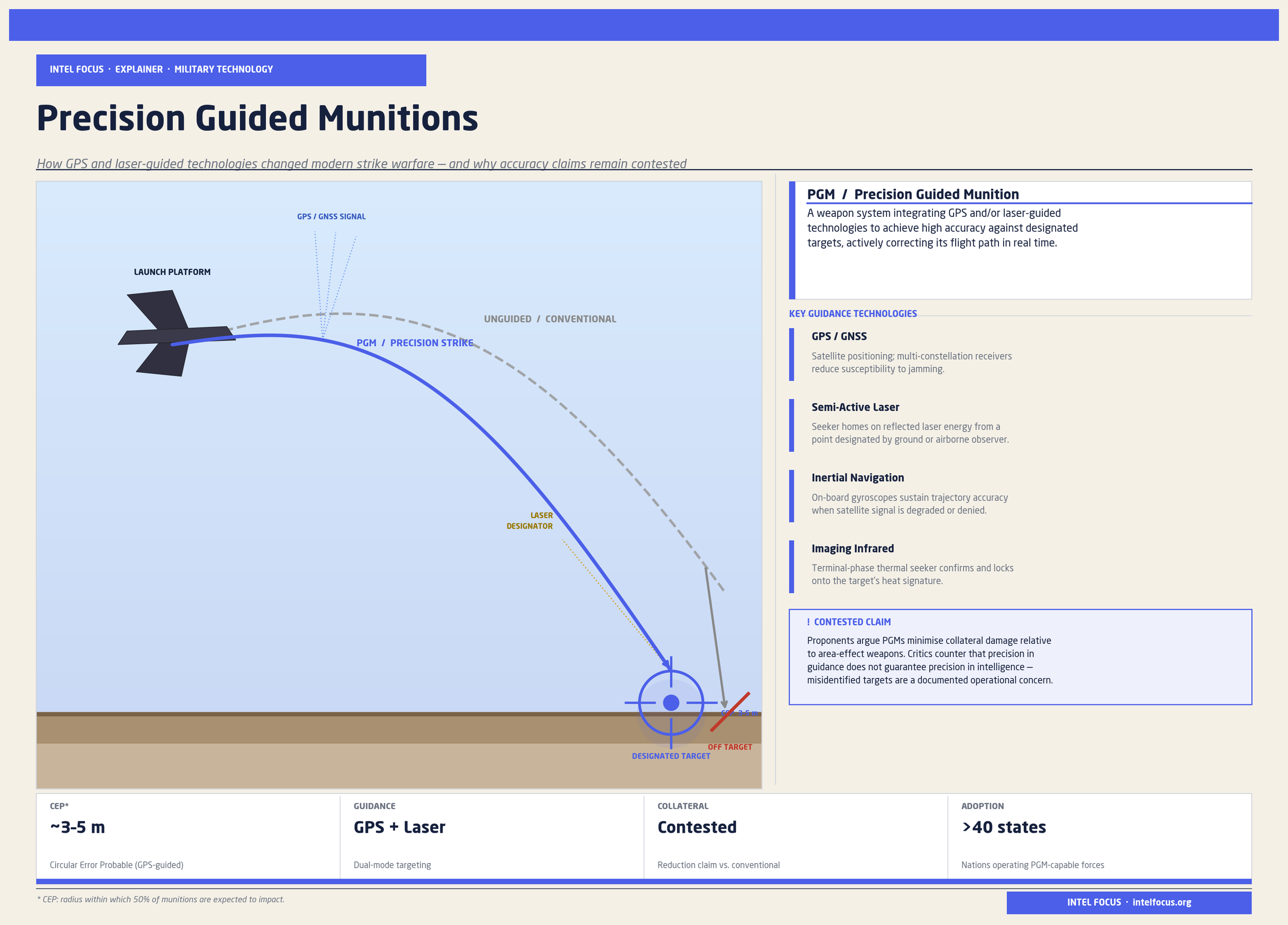
Figure: This visual explains how Precision Guided Munitions (PGMs) work.
Although the history of such weaponry can be traced back all the way to Fritz X, which was used by the Germans in WWII, the 1991 Gulf War has been cited as the turning point for demonstrating the effectiveness of precision munitions. PGMs accounted for only 9% of the total ammunition dropped during the war, but caused 75% of the damage to the targets.
This shift helps explain the increased appearance of the term “precision strike” in the 1990s, a trend that is reflected in data from Google Ngram Viewer, which shows a noticeable rise in the term’s usage in published texts during that period.
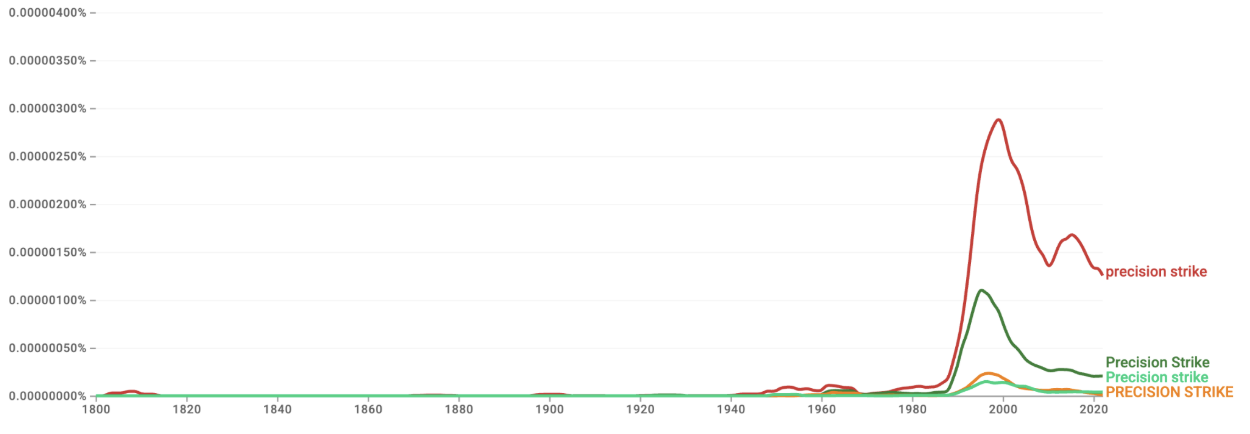
Figure: Image showing the graph in the usage of the term ‘Precision Strike’.
Although the Google Trends data is only available from 2004 onward, it still provides insight into recent interest in the term. The highest search activity occurred in September 2025, coinciding with reports of Israel’s strike in Doha targeting Hamas leaders, and again in March 2026 amid escalating tensions and reported attacks between the United States and Iran.
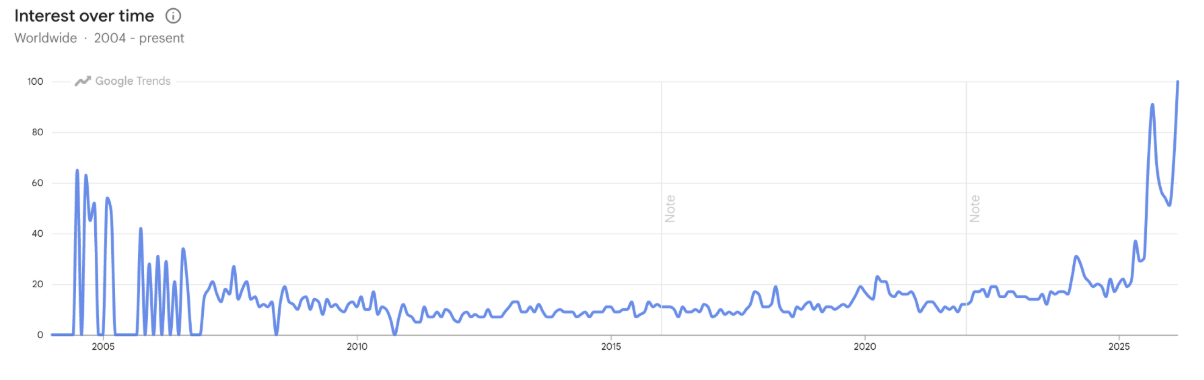
Figure: Image showing interests in search terms
The U.S. Central Command X account recently revealed that long-range Precision Strike Missiles (PrSMs) were used during Operation Epic Fury, targeting Iran. In another statement by the Department of Defence in 2025, the U.S. announced that a series of precision strikes had been conducted against Iran-backed Houthis targets across Yemen. These strikes are described as responses to the attacks on U.S. military and commercial shipping vessels. In this statement, the strikes are not just described as precise but also as legitimate responses to provocation and followed by maximalist language such as “U.S. would continue using overwhelming lethal force”. This tension reveals that “precision strike” might be less about accuracy and more about legitimising the target selections.
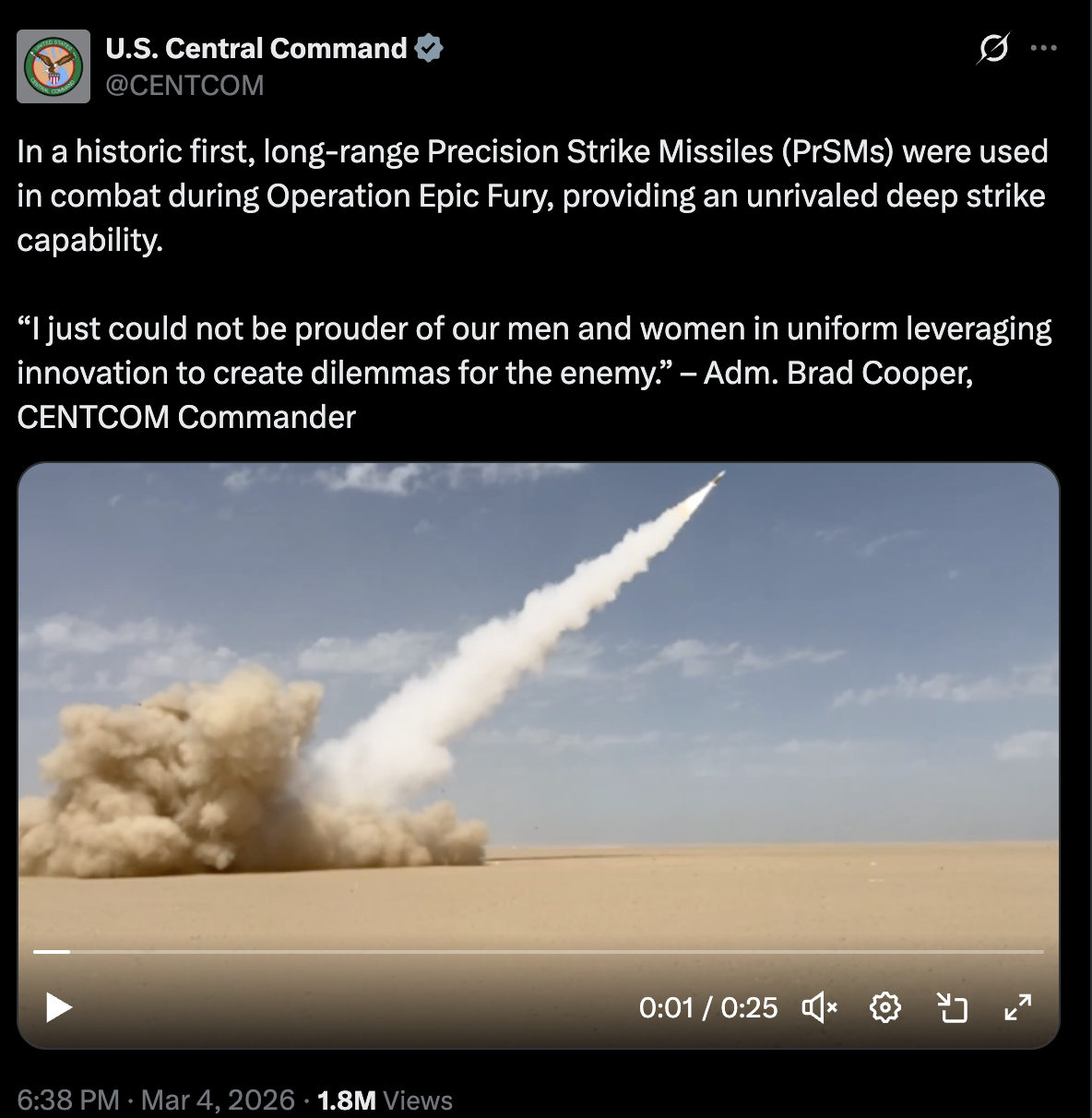
Figure: Screenshot from a CENTCOM post on X/Twitter.
On October 29, 2025, the Israeli military announced the conduct of a precision strike on a site that they mentioned had weapons stockpiled and posed an “imminent terror attack”. The operation left over 100 people dead.
Examples of similar language can be seen in reporting on Israeli military operations. In an article by Le Monde covering Israeli strikes in the Gaza Strip, the operation was described as targeting an alleged weapons site following a night of heavy bombardment that reportedly left over 100 people dead. According to the Israel Defence Forces, as reported in the Jerusalem Post, the strike was framed as a targeted or precise operation against militant assets, illustrating how the language of “precision” is commonly used to present military actions as focused and controlled despite the broader destruction reported on the ground.
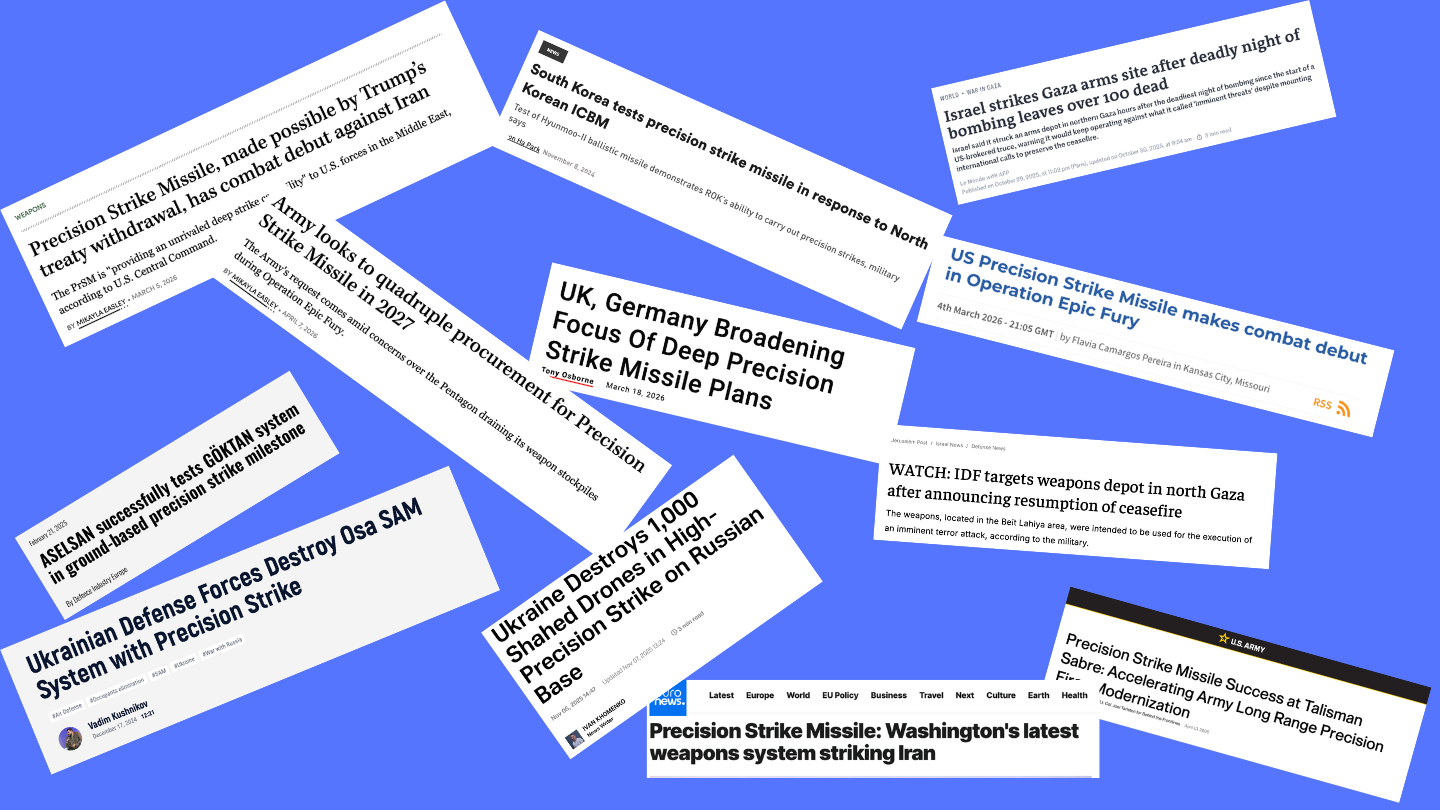
Figure: Image showing the news headlines with the term ‘Precision Strike’.
Across different conflicts and political contexts, the term “precision strike” has become a standardised feature of modern military communication, used by governments to frame attacks as controlled, accurate, and directed at legitimate targets.
As seen in the Israeli example, these “precision strikes” have on multiple occasions caused major damage and civilian casualties.
Precision language connects directly to International Humanitarian Law concepts like distinction and proportionality. Militaries use the term partly because it signals legal compliance.
In this context, the growing use of the term “precision strike” reflects more than just a technological development in warfare. It has also become a strategic communication tool used by governments to frame military operations as controlled, lawful, and directed at legitimate targets. While precision-guided technologies have undoubtedly improved targeting capabilities since the Gulf War, the widespread adoption of this language in official statements and media reporting suggests that the term now plays an important role in shaping how modern warfare is presented to the public.
