Green branding but dirty sourcing: How selective disclosure sustains the clean energy transition while exporting harm
Author & Investigator: Mariana Balona
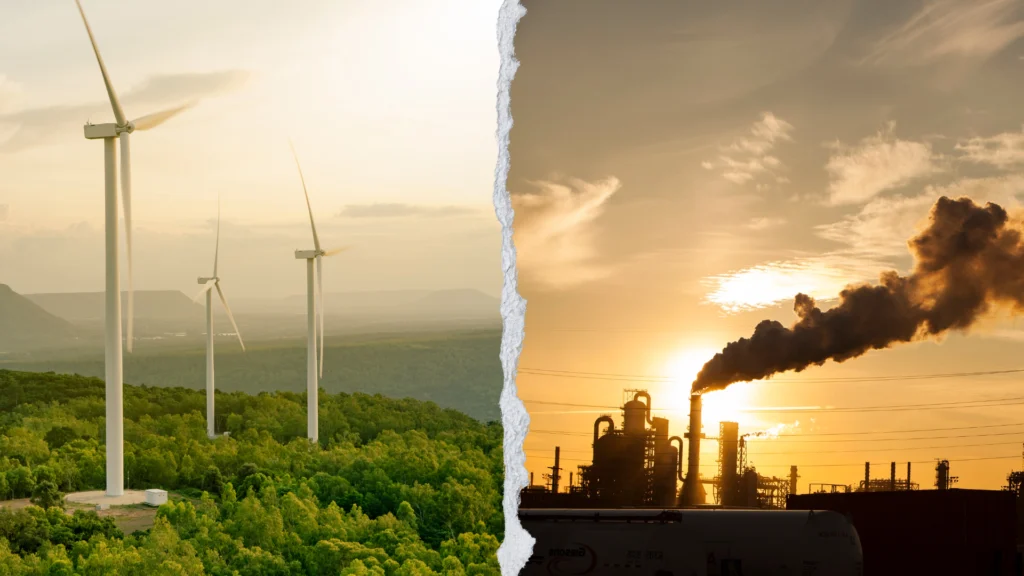
As governments and corporations accelerate the clean energy transition, electric vehicles, wind turbines, and battery storage systems are increasingly framed as unambiguous climate solutions. Corporate sustainability reports and policy briefings praise emissions cuts and ‘responsible sourcing.’ But behind the green branding lies a mineral economy built on toxic extraction, polluted water, and deep social disruption, whose costs are largely carried by distant communities with weaker oversight.
This investigation examines how selective disclosure allows climate-focused companies and institutions to present mineral-intensive technologies as sustainable while externalising environmental and social harm.
Green branding vs. dirty sourcing
The International Energy Agency (IEA) has cautioned that the clean-energy transition can “succeed on paper” while failing people and ecosystems on the ground (International Energy Agency [IEA], 2023). Wind, solar, electric vehicles (EVs), and batteries may reduce emissions in consuming countries even as the mining and processing of copper, cobalt, lithium, nickel, and rare earths contaminate water, generate hazardous waste, and breach human-rights norms upstream.
A UN Department of Economic and Social Affairs (UN DESA) policy paper similarly warns that linear supply chains for energy-transition minerals drive habitat destruction and pollution in producer countries, effectively transferring ecological burdens from wealthy consumers to extraction zones with weaker safeguards (UN DESA, 2023). Climate benefits are celebrated at one end of the chain; at the other, ecological damage is quietly accepted as collateral.
Burden shifting and land-connected communities
Research published in Nature Sustainability finds that more than half of known reserves for key transition minerals overlap with Indigenous or peasant lands (Owen et al., 2022). From lithium brine extraction in South America to nickel laterite mining in Southeast Asia, projects framed as climate solutions often bring water depletion, contamination, and social conflict to communities with limited political leverage.
These findings echo the Extractive Industries Transparency Initiative’s Mission Critical report, which documents deforestation, water pollution, and governance risks across mineral-producing states supplying the clean-energy transition (Extractive Industries Transparency Initiative [EITI], 2022). While importing countries frame these minerals as indispensable to climate leadership, producer states are left managing tailings dams, acid mine drainage, and long-term contamination.
Rare earths: clean tech’s radioactive shadow
Rare earth elements sit at the heart of the clean energy boom and reveal just how fragile the line is between green branding and dirty sourcing. Scientific reviews show that rare earth mining and processing generate radioactive tailings, toxic wastewater, and airborne pollutants, particularly during chemical separation stages (Andrea S., et al. (2022).
These impacts are largely absent from consumer-facing sustainability narratives. As EITI (2022) notes, producer countries face intensified risks of corruption and weak enforcement as demand rises, while downstream industries benefit from rare-earth-enabled efficiency gains.
ESG and selective disclosure
UN DESA highlights how fragmented, globally dispersed supply chains make it difficult to trace environmental and social impacts from mine to final product (UN DESA, 2023). Hence, companies can report reduced operational emissions and highlight ESG certifications while remaining silent on upstream pollution.
As governance responsibilities fragment across miners, traders, refiners, and brand-name manufacturers, accountability dissipates ground (International Energy Agency [IEA], 2023). This fragmentation enables selective disclosure: companies emphasise what they measure and control, while site-level impacts on water, waste, and health remain out of frame.
Case study: Lynas and the “clean” rare earth narrative
Lynas Rare Earths presents itself as a cornerstone of responsible rare earth supply for the energy transition. Yet its cracking and leaching plant in Kuantan, Malaysia, has faced more than a decade of protests over radioactive waste and wastewater management.
Malaysian authorities have repeatedly renewed Lynas’s licence with strict conditions, reflecting persistent concerns over long-term waste storage (Australian Broadcasting Corporation [ABC], 2019). Civil society organisations argue that unresolved waste issues continue to expose local communities to environmental risk (Independent Australia, 2023).
These concerns are echoed in public discourse online. On Reddit, users discussing Lynas frequently challenge the company’s green branding, describing the Malaysian facility as “the dirty end of clean energy” and criticising how waste risks are excluded from EV narratives (Reddit user discussion, r/environment, 2023). While anecdotal, such discussions illustrate how selective disclosure is increasingly contested outside formal policy arenas.
Case study: “beneath the green” – industrial cobalt in the DRC
In the Democratic Republic of Congo (DRC), cobalt mining underpins the global EV supply chain. Corporate ESG reports highlight responsible sourcing and decarbonisation benefits. However, the NGO report Beneath the Green documents polluted rivers, heavy-metal contamination, dust exposure, and health impacts around major industrial mines (RAID, 2024).
On social media platforms, Congolese activists and international observers amplify these findings. Public posts on X using hashtags such as #CongoIsBleeding and #GreenButDirty links EV marketing directly to cobalt pollution and community harm, criticising what one widely shared post called “green mobility built on toxic sacrifice zones” on X in 2024.
Reddit discussions in forums such as r/climateskeptics and r/technology from 2023–2024similarly contrast EV advertising with reports of contaminated water near mining sites, reinforcing how grassroots discourse fills gaps left by corporate reporting.
Case study: Savannah lithium and Europe’s green transition
Savannah Lithium’s proposed open-pit mine in Portugal’s Barroso region is framed as a strategic contribution to Europe’s green transition. Company communications emphasise sustainability, jobs, and regulatory compliance.
Local communities tell a different story. Residents have filed legal actions alleging unlawful appropriation of communal lands and risks to water and traditional agro-pastoral systems (Business & Human Rights Resource Centre, 2022; Reuters, 2023).
These concerns are mirrored on Facebook, where local citizen groups have organised opposition pages warning that “Europe’s green batteries are being built by destroying protected landscapes”(Public Facebook group post, 2023). Such posts highlight how local knowledge and lived experience often remain absent from EU-level sustainability narratives.
Case study: Myanmar rare earths and China’s clean-tech image
China’s dominance in rare earth processing underpins global clean-tech supply chains, and official narratives emphasise technological sophistication and improved domestic environmental standards. Yet investigative reporting and community testimonies from Myanmar describe water contamination, erosion, and social disruption linked to poorly regulated rare earth extraction in conflict-affected regions (Owen et al., 2022).
While cleaner processing at home is highlighted, the most environmentally destructive extraction remains effectively outsourced and largely invisible in official narratives.
EU funding and institutional blind spots
Selective disclosure also extends to public institutions. Investigate Europe has shown that companies linked to environmental controversies have received EU research and innovation funding under programmes framed as supporting sustainable mining (Investigate Europe, 2023). At the programme level, communications stress innovation and strategic autonomy, while unresolved environmental conflicts remain marginal.
Online reactions to these revelations, shared widely on Reddit as well as X on 2022, frequently accuse EU institutions of “greenwashing with public money,” reflecting growing scepticism toward official sustainability claims.
Conclusion: selective disclosure as a structural feature
Across minerals, regions, and governance levels, a consistent pattern emerges. Green branding prioritises climate metrics, technological solutions, and high-level ESG frameworks. Dirty sourcing, creating polluted water, degraded land, and marginalised communities, remains concentrated in the shadows of fragmented supply chains and weak oversight.
Public discourse on Reddit, Facebook, and X does not merely echo academic critiques; it exposes how affected communities and observers actively contest selective disclosure. For journalists, the task is not only to document individual abuses but to reveal how selective disclosure itself has become a structural feature of the energy transition, allowing climate virtue at home while environmental and social costs are paid elsewhere.
More investigations
View all
The apps that watch you: how stalkerware enables tech-facilitated abuse
Apps sold as parental control let abusers read a partner’s messages, track their location and stay hidden. Intel…

How propaganda travels across borders and online platforms
A comparison of how pro-Taliban, pro-Russia, pro-China and pro-Iran networks produce and amplify propaganda, and how organic and…
Insurgent attacks in southern Thailand: geolocation and analysis
Nine attackers, ninety seconds and two CCTV cameras. Intel Focus geolocates the checkpoint ambush that killed five Thai…